
 Heifereum Research Desk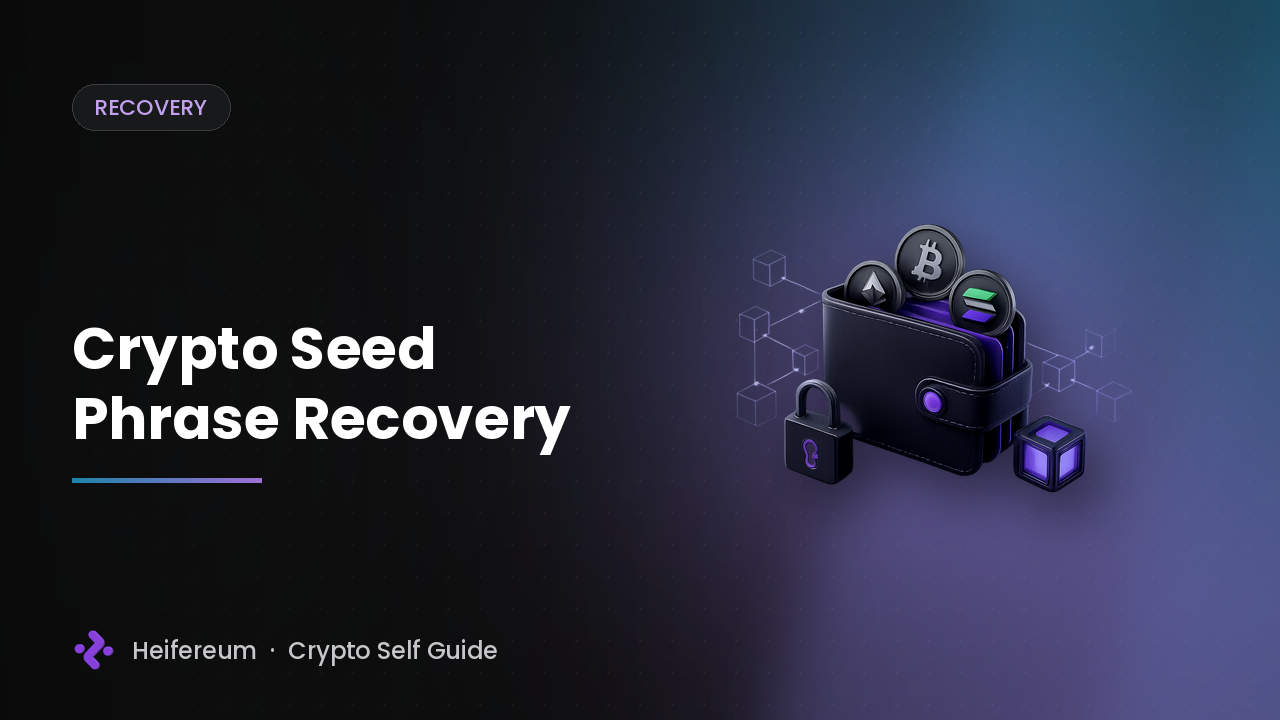
Crypto wallet recovery is not about breaking blockchain encryption. It works by using information the owner still remembers to reduce an enormous guessing problem into a smaller, searchable one.
What Recovery Tools Do
Recovery tools may help when someone has:
- Missing seed words
- Incorrect seed words
- Correct words in the wrong order
- A forgotten wallet password
- A forgotten BIP-39 passphrase
- The correct seed but the wallet appears empty
- A damaged device or corrupted wallet file
They cannot recover a completely unknown private key or seed phrase using only a public wallet address.
How Seed Recovery Works
A standard BIP-39 seed phrase uses words from a fixed list of 2,048 words. A 12-word phrase also contains a built-in checksum that allows software to reject most incorrect combinations.
The recovery process:
- Generate possible missing or corrected words.
- Reject combinations with an invalid checksum.
- Convert valid phrases into wallet seeds.
- Generate addresses using possible derivation paths.
- Compare the generated addresses with a known public address.
- Stop when a matching wallet is found.
A public address helps verify the answer, but it cannot be reversed to reveal the seed.
What Is Realistically Recoverable?
The estimates below assume:
- A standard 12-word BIP-39 phrase
- The missing positions are known
- The remembered words are correct
- No additional passphrase was used
| Scenario | Approximate valid candidates | Outlook |
|---|---|---|
| 12 words known and ordered | 1 | Immediately usable |
| 11 of 12 words known | 128 | Very easy |
| 10 of 12 words known | 262,144 | Usually practical |
| 9 of 12 words known | 537 million | Possible with strong computing and clear wallet details |
| 8 of 12 words known | 1.1 trillion | Usually impractical |
| 6 of 12 words known | 4.6 quintillion | Effectively impossible |
| 0 of 12 words known | 3.4 × 10³⁸ | Cryptographically impossible |
Knowing ten words does not automatically mean recovery is easy. The difficulty increases when the missing positions are unknown, the word order is uncertain or the wallet type is not known.
Other Recovery Scenarios
All 12 Words Known, But Wrong Order
There can be up to:
12! = 479,001,600 arrangements
The checksum removes most invalid arrangements, but millions may still remain.
Recovery may be possible when the owner has a known address and some clues about which words were moved or grouped together. BTCRecover supports swapped-word and descrambling cases.
One Word Is Incorrect
Software replaces the incorrect word with words from the BIP-39 list.
It may prioritize:
- Similar spellings
- Similar handwriting
- Words with the same beginning
- Accidentally duplicated words
- Words located near each other on a written backup
This is normally one of the easiest recovery scenarios.
Correct Seed, But Wallet Is Empty
The seed might be correct, but the software may be checking the wrong:
- Blockchain
- Account number
- Derivation path
- Address type
- Legacy or SegWit format
- BIP-39 passphrase
Every passphrase creates a different valid wallet. An incorrect passphrase does not show an error—it simply opens another wallet.
Forgotten Wallet Password
This is different from a missing seed.
The recovery tool tests likely passwords against an encrypted wallet file. Success depends heavily on clues such as:
- Old passwords
- Common numbers
- Capitalisation habits
- Dates
- Keyboard patterns
- Known password length
A human-created password may be recoverable. A long, truly random password with no clues may not be.
Damaged Device or Deleted Wallet File
This requires device or data forensics rather than seed guessing.
Possible methods include:
- Recovering deleted wallet files
- Extracting data from damaged storage
- Examining old computer backups
- Reading data from outdated hardware wallets
- Repairing corrupted wallet databases
Recovering the wallet file does not guarantee that its password can also be recovered.
Main Recovery Tools
BTCRecover
The main open-source framework for:
- Missing seed words
- Incorrect words
- Swapped words
- Forgotten passwords
- BIP-39 passphrase recovery
- Multiple wallet types and blockchains
It can verify candidates using a wallet file or known public address.
FinderOuter
A Bitcoin-focused open-source recovery tool with a graphical interface.
It supports damaged mnemonic phrases, private keys, derivation paths, BIP-38 keys and some Bitcoin wallet passwords.
Hashcat
A general GPU-powered password recovery tool.
It is mainly useful for testing passwords against supported encrypted wallet data. It is not designed to randomly discover complete seed phrases.
Paid Recovery Services
Paid specialists are useful when recovery requires:
- Custom software
- Large GPU systems
- Unusual wallet formats
- Corrupted files
- Damaged devices
- Legacy hardware vulnerabilities
Many use a success-fee model. Reuters reported in 2024 that two established recovery firms charged approximately 20% of the recovered wallet, payable only after successful recovery.
The percentage can become expensive, but the owner is paying for specialist knowledge and a result that may otherwise remain inaccessible.
Can AI Recover Seed Phrases?
AI can help with:
- Organising remembered clues
- Recognising possible spelling errors
- Identifying wallet formats
- Creating better password candidate lists
- Prioritising human-created password patterns
- Analysing old files and backups
AI cannot:
- Predict genuinely random missing words
- Reverse a public address into a private key
- Break modern wallet cryptography
- Recover a completely unknown seed phrase
AI reduces human uncertainty. The actual recovery still depends on systematic searching and cryptographic verification.
Real-World Examples
In 2017, a WIRED editor recovered 7.4 BTC from a locked Trezor after a security researcher used a vulnerability in its older firmware to extract the seed and PIN. This was a device exploit—not a successful guess of a random seed phrase.
In 2024, Reuters interviewed nearly a dozen locked-out crypto holders. Six had contacted recovery companies and successfully regained access to their holdings. Recovery requests increased as Bitcoin prices rose, because previously abandoned wallets became valuable enough to justify specialist fees.
Main Risks
- Fake recovery websites
- Telegram and WhatsApp impersonators
- Malware disguised as recovery software
- Guaranteed-recovery promises
- Requests for upfront “gas” or “unlocking” fees
- Unknown software requesting the full seed phrase
- Remote access to the owner’s main computer
An academic investigation attracted more than 9,000 scam accounts using fake wallet-support posts. Scammers commonly moved victims to Telegram, email or other private channels before requesting seed phrases or payments.
Recovery should be performed offline wherever possible. Once a seed has been entered into recovery software or shared with a specialist, the recovered assets should be moved into a completely new wallet.
Conclusion
Crypto recovery is a process of searching, filtering and verification.
It works when enough information remains to make the number of possible answers manageable. Ten remembered words may be enough. Six usually are not.
The tools do not defeat cryptography. They reconstruct human mistakes.